220th MSL Lecture
“Treasuring Trash: Plastic Upcycling”(2026/8/17)
| Date/Time | August 17 (Mon.), 2026, 15:00 – |
| Place | J1 Bldg. Room 809, Yokohama campus (Map No.28) |
| Organizer | Materials and Structures Laboratory |
| Contact | Azuma Lab. Masaki Azuma (Ext. 5315) |
| Language | English |
Subject & Detail

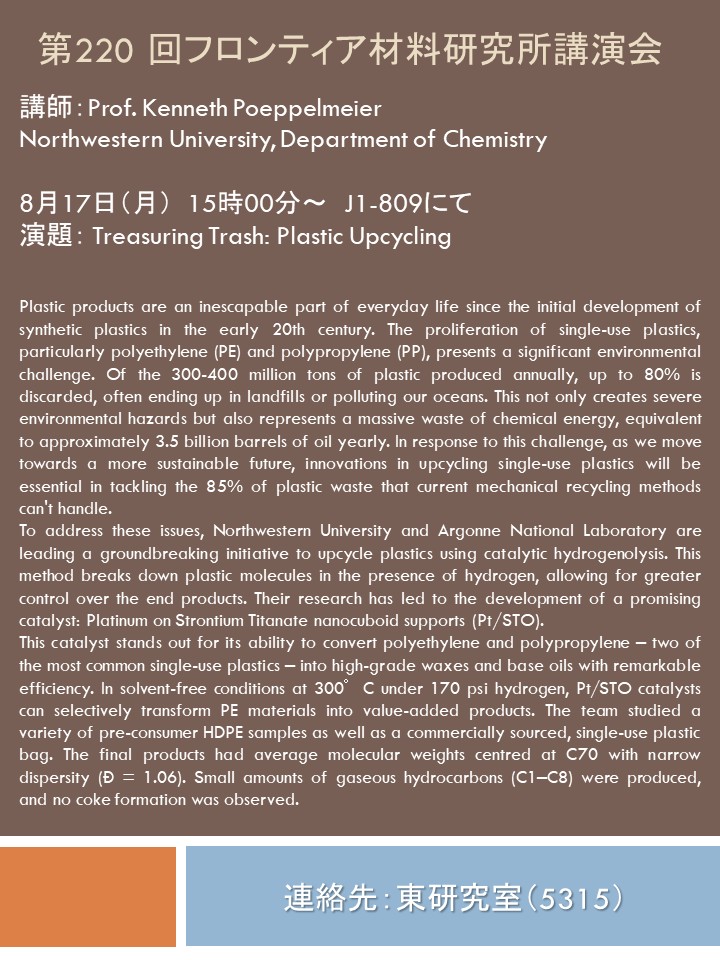
Speaker: Prof. Kenneth Poeppelmeier (Northwestern University, Department of Chemistry)
Lecture theme: Treasuring Trash: Plastic Upcycling
Abstract:
Plastic products are an inescapable part of everyday life since the initial development of synthetic plastics in the early 20th century. The proliferation of single-use plastics, particularly polyethylene (PE) and polypropylene (PP), presents a significant environmental challenge. Of the 300-400 million tons of plastic produced annually, up to 80% is discarded, often ending up in landfills or polluting our oceans. This not only creates severe environmental hazards but also represents a massive waste of chemical energy, equivalent to approximately 3.5 billion barrels of oil yearly. In response to this challenge, as we move towards a more sustainable future, innovations in upcycling single-use plastics will be essential in tackling the 85% of plastic waste that current mechanical recycling methods can’t handle.
To address these issues, Northwestern University and Argonne National Laboratory are leading a groundbreaking initiative to upcycle plastics using catalytic hydrogenolysis. This method breaks down plastic molecules in the presence of hydrogen, allowing for greater control over the end products. Their research has led to the development of a promising catalyst: Platinum on Strontium Titanate nanocuboid supports (Pt/STO).
This catalyst stands out for its ability to convert polyethylene and polypropylene – two of the most common single-use plastics – into high-grade waxes and base oils with remarkable efficiency. In solvent-free conditions at 300°C under 170 psi hydrogen, Pt/STO catalysts can selectively transform PE materials into value-added products. The team studied a variety of pre-consumer HDPE samples as well as a commercially sourced, single-use plastic bag. The final products had average molecular weights centred at C70 with narrow dispersity (Ð = 1.06). Small amounts of gaseous hydrocarbons (C1–C8) were produced, and no coke formation was observed.